Learn
The Roof Questions West Orange Owners Ask, Answered From the Public Record
A ceiling stain, a borrowed ladder, a storm and a knock at the door raise the same worry: what comes first? Seven short answers from federal, state and township pages, written for owners in West Orange, Orange, Millburn, Roseland and Essex Fells.
Where do I look first when a ceiling stain appears?
Start indoors and work outward. A ceiling stain marks where water landed, which is often not where it got in. The attic comes next. ARMA names flashing as the weakest spot on a roof and suggests checking it from the attic for water stains. The Department of Energy adds that wet insulation needs to be pulled before the ceiling beneath it can dry.
Then go outside and stay on the ground. ARMA recommends a visual check from the yard or an upstairs window, with binoculars if needed. Take in the ridge, the edges, the chimney and each vent pipe, and photograph what you see before anything is moved.
Why is a ladder the wrong tool for this look?
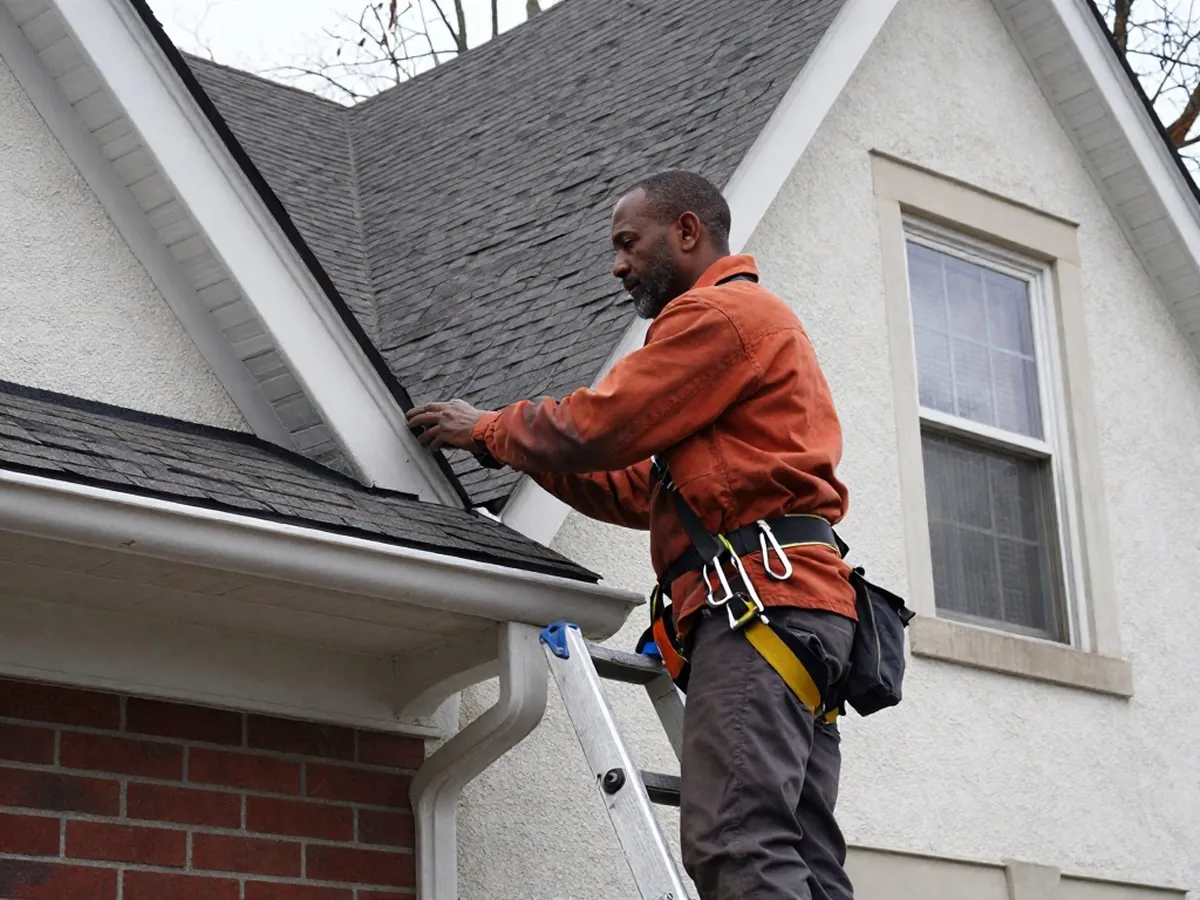
NIOSH, the federal workplace-safety institute, reports that upward of 100 people in the United States die from ladder falls every year, and thousands more are hurt. Its advice is specific: a ladder angle of about 75 degrees, three points of contact while climbing, a ladder that reaches three feet above the roof edge, and level, firm ground underneath.
Power lines raise the stakes. NIOSH advises a clearance of ten feet from them and a nonconductive ladder wherever wires are live. A wet, frosty or gusty roof adds slipperiness on top. For an owner, binoculars and a notebook do the job; the ladder belongs to the roofer.
What comes first after a storm: wires, the ceiling or the claim?
Wires, then people, then the roof. PSE&G's guidance on downed lines says to treat any downed wire, even a phone or cable line, as live; to stay back; never to put water on it; and to call 911 or the utility. A ceiling that bulges or sags comes next: keep everyone out from under it.
Insurance comes after that. New Jersey's insurance department advises reporting the loss to the agent or insurer, photographing damaged property before it is thrown away, making temporary repairs that protect the property, and saving every receipt. It adds that the policyholder need not hire the contractor the insurer recommends.
How do I judge a stranger who knocks after a storm?
ARMA relays a warning from the NRCA, the roofing contractors' association, that storms draw crews from outside the area. The traits it lists for a contractor are a permanent business location, recent references and a written proposal, and it urges care with anyone who wants payment in advance.
Many sales made at a buyer's home can be undone within three business days, a window set by the Federal Trade Commission's Cooling-Off Rule. Exceptions apply: a sale you requested to get a repair done, and an emergency sale, fall outside it. The rules page lists what a New Jersey home improvement contract has to contain.
What do older West Orange houses mean for the roof?
West Orange's median house was built in 1956, per the Census Bureau's 2024 estimate, and 59 percent of its units date from before 1960. A house that age has usually been re-roofed at least once, and each re-roof may have added a layer. The township handout allows two. The date of the last roof is the number worth finding.
Age reaches the attic too. On ice dams, the Building America Solution Center lists air sealing first, then insulation, then continuous ventilation, and the attic is where a roofer checks all three.
Where does all the roof water go?
A roof drains more water than most people picture. Rutgers' Water Resources Program works an example: roughly 500 gallons run off a roof area of 800 square feet when an inch of rain falls, all of it passing through the gutters and out of the downspouts.
Where it lands matters. The EPA notes that downspouts emptying onto a driveway send water to the street, and that some are tied into underground pipes that carry it to a sewer or storm drain. It points to lawns and gardens as a place for water to soak in, with the caution that disconnecting is not right everywhere. West Orange's handout counts replacing gutters or leaders as an ordinary repair.
Five numbers worth knowing
How many layers of roofing can a West Orange house carry?
Two, says the township's building handout.
How close to a power line can a ladder go?
No closer than ten feet, says NIOSH.
How long does standing water sit before a low roof counts it as ponding?
48 hours, says ARMA.
How much water does one inch of rain send off 800 square feet of roof?
About 500 gallons, says Rutgers.
How long is the cancellation window on many sales made at home?
Three business days under the FTC's Cooling-Off Rule, with exceptions.
When does a question turn into a job?
When the stain keeps growing, the attic is wet, or a storm left an opening, the questions above stop being enough. A roof inspection looks at the whole roof, and roof repair deals with the spot where water gets in.
Dial (973) 841-8483 with the street address, what you have seen and about when the roof went on. Tenants: roof work is the owner's to arrange, so the landlord hears first.
Call (973) 841-8483 and talk the roof through.
Call (973) 841-8483Keep three things handy: the address, a description of the damage and a rough roof age. Renters: roof work is set up by the owner, so the landlord comes first. Dial (973) 841-8483 if you are in one of the five towns listed here.